 All Guides ↗
The price of a sealed box is ultimately a bet on what comes out of it. Pull rates turn that bet into numbers: the odds of each rarity, how many you should expect per box, and the expected value of a single pack. Here is how to read them.
A pull rate is the probability of hitting a given rarity. "1 in 5.5 packs" for Rare Holo means, on average, you open about five and a half packs per Rare Holo. Multiply across a full box and you get an expected count per box, and if you attach market prices to those cards you get expected value, the average dollar value of cards you would pull if you opened the product.
This is the number that anchors a sealed box to reality. If a box costs far more than the expected value of its contents, you are paying a premium for scarcity and demand, which can be justified, but you should know you are doing it. If a box trades near or below its pull value, the downside is cushioned by what is inside.
Two boxes at the same price are not equal. The one with the stronger chase and higher expected value has a firmer floor, because openers will keep cracking it for the hits, which drains sealed supply faster.
Evolving Skies is one of the most opened modern sets, prized for its alternate-art chase cards like the Umbreon VMAX. Here are its verified per-box pull rates, straight from the platform. What matters is not any single number but the shape of what an average box contains, and how far the sealed price now sits above it.
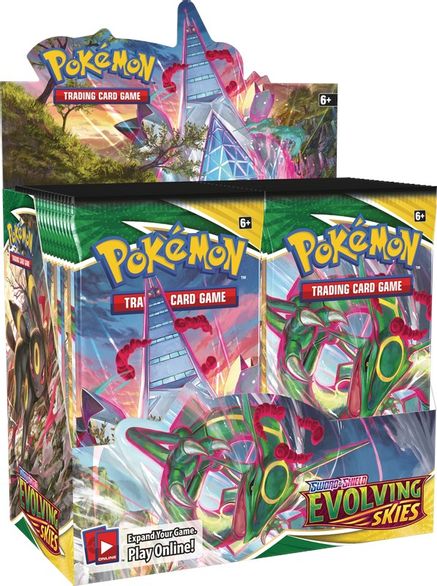
Here is the key. This box is out of print and now trades around $2,659, roughly $74 per pack on the secondary market. An average box does not open anywhere near that. Most of the cards are commons and Rare Holos, and the real money hides in a small number of rare chase hits that you are not guaranteed to pull. When a sealed box trades far above what it opens for, the market is telling you it values the box as a frozen, shrinking collectible, not as expected value to crack. And every box that does get opened for the chase only thins the remaining sealed supply further.
Expected value is an average, not a promise. Any single box can under-deliver or hit big. As an investor you are not trying to beat the odds on one box, you are using pull data to judge which sealed products have the demand structure to keep appreciating. Three questions to ask of any set:
A set with a beloved alternate art or a valuable secret rare will be opened relentlessly, which drains sealed supply. Weak chase, weak opening pressure.
A widening gap between a rising box price and a stable pull value signals that the market is paying up for scarcity, often a sign supply is tightening.
Once a set goes out of print, opening no longer gets replaced by fresh boxes, and pull-driven destruction starts to bite the float directly.
TCG Quant tracks supply, demand, pull rates, destruction, and Long-Term Scores across Pokemon and One Piece sealed product, updated daily.
Explore TCG Quant →