 All Guides ↗
The entire sealed thesis rests on one assumption: that supply is finished. A reprint is the publisher announcing it is not. No other single event moves sealed prices as hard, as fast, or as predictably, which is why the best sealed investors do not merely hope reprints away. They read the risk before buying, size around it, and understand what a reprint does, and does not do, to a product's long-term story.
A reprint is new factory-sealed supply of an existing set arriving after the original print run, and it is the largest single risk a sealed position carries. Reprints arrive in waves while a set is in the publisher's active window, sometimes as scheduled cycles, sometimes as surprise restocks, and modern publishers increasingly print toward demand rather than toward a fixed number. You cannot know a print run's size, but you can read the risk: set age, era status, publisher habits, and product tier are all visible before you buy. And a post-reprint price drop, while painful, does not automatically destroy the long-term case, because every reprint window eventually closes.
Strip away the artwork and the nostalgia and a sealed position is a bet that supply of this exact product will never increase again, while demand persists or grows. Every other factor this curriculum covers, chase strength, destruction, lifecycle stage, operates inside that assumption. A reprint suspends it. When new sealed cases land at retail price, the scarcity premium built into the secondary price has to be rebuilt from a larger base, and the market reprices immediately, usually downward, and usually before the boxes physically arrive.
This is why reprint risk cannot be treated as one factor among many. It is the gate in front of all the others. A set with a magnificent chase lineup and heavy opening demand is still not scarce if the publisher is about to print more of it. Scarcity is not a property of how hard a product is to find this month. Scarcity begins on the day the publisher stops printing, and not one day before.
The reprint window is the stretch of a product's life during which the publisher can still, realistically, print more. While the window is open you are buying a product; only after it closes are you buying a scarce asset.
Reprints do not come with press releases addressed to investors. They arrive in a few recognizable shapes, and learning the shapes is most of the defense.
Scheduled waves. While a set is in its active window, publishers commonly plan multiple print waves from the start. The first run sells through, a second wave lands weeks or months later, and a strong seller may see several. Early sell-outs during this phase are marketing events, not scarcity events, and prices built on first-wave hype routinely deflate when the next wave ships.
Surprise restocks. A product everyone assumed was finished reappears on retail shelves or in a publisher's online store. These sting the most because the market had already started pricing in scarcity; positions bought on that assumption take the mark-to-market hit overnight. Products with evergreen demand and special or anniversary branding are the classic candidates, precisely because the publisher knows they will sell.
Print-to-demand. The most important structural shift in the modern hobby. Rather than committing to a fixed run, publishers extend printing for as long as demand justifies it. The honest implication for an investor: while a hot modern set is inside this regime, its effective supply is not a number, it is a faucet. You are no longer asking "how many exist?" but "when does the faucet close?"
Print-run sizes are not published, so you will never compute this risk precisely. You can still grade it. Run every prospective buy through the checklist below; each row is observable from public information before you spend a dollar.
| Factor | What to ask | Risk falls when… |
|---|---|---|
| Set age | How long since release? Is product still shipping to retail? | The set is years past release and fresh cases have visibly stopped arriving. |
| Era status | Is the set's era (block/generation) still current? | The era has ended. Publishers overwhelmingly print for the current era; a closed era is the strongest practical signal the window is shut. |
| Publisher pattern | What has this publisher historically done with sets like this one? | The publisher's track record shows reprints concentrated in the active window, not reaching back years. |
| Product tier | Mainline expansion, or special/anniversary product? | You know which tier you hold. Special sets follow their own print logic and have produced some of the hobby's most famous surprise restocks; price them with extra caution. |
| Demand pressure | Is this set selling so well that reprinting is free money for the publisher? | Attention has rotated to newer sets, so the commercial motive to reprint has faded. |
| Retail presence | Is it on shelves and in stock at major retailers right now? | It has been absent from retail through multiple restock seasons, not just sold out this week. |
No single row settles the question. A young set can fail every row and still be a fine trade at the right price; an old set can pass every row and still be a poor hold if nobody wants it. The checklist's job is narrower: to stop you from paying a scarcity premium for a product whose supply is still a faucet.
The live pair below is the checklist made visible. The first is a modern chase product from a set the publisher has kept printing through wave after wave of demand; the window is open, and its price behavior is dominated by the supply faucet. The second is a Sword & Shield era booster box whose era has ended: the window is closed, the run is what it is, and from here destruction does the work.
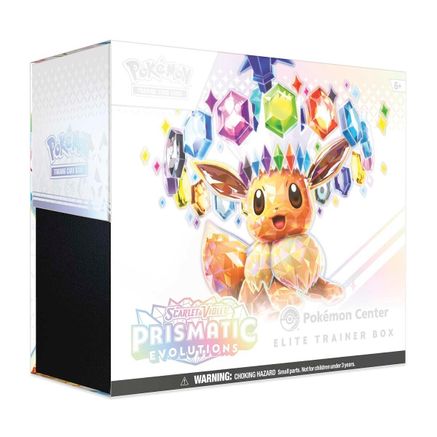

Notice what the comparison is not saying. It is not saying Prismatic Evolutions is a bad product, or that Evolving Skies is automatically a buy at $2,450.44. It is saying they are different kinds of position. One is a bet on when a faucet closes and how much demand survives the flood. The other is a bet that already-finished supply keeps shrinking into persistent demand. Price them, size them, and judge them by different rules.
Reprint waves announce themselves in inventory before they announce themselves in price. When a restock lands, the platform's active-supply chart shows the new listings arriving as a visible wave, often while the price line is still flat. Watching supply, not just price, is how you see the faucet reopen days before the market finishes reacting to it.
The scenario investors fear most, buying a box and watching a reprint knock the price down, deserves a calmer look than it usually gets. A reprint changes the supply base and resets the scarcity clock. What it does not do is repeal the forces that made the product worth watching: if the set's chase cards still pull people in, every new box printed is a future box opened, and the destruction engine simply gets more fuel. Some of the hobby's most valuable sealed products went through multiple print waves in their active years; the scarcity that eventually made them valuable was built after the last wave, from whatever supply survived the opening frenzy.
So a post-reprint decline is a mark-to-market event, not necessarily a thesis-ending one. The questions that decide which it is: Did demand survive? Is the window now more likely closed, with the publisher's attention moved on? And is your cost basis low enough to let you wait out the rebuild? A reprint at 2x retail hurts; the same reprint hurts far less for the investor who refused to pay a scarcity premium while the window was open, which is precisely the discipline of section 04. The honest failure case is different: a reprint landing on a set whose demand was already fading. That is not a delay, that is the market telling you the demand half of the thesis was wrong, and supply just made it obvious.
1. Scarcity starts when printing stops. Until the window closes you are holding a product, not a scarce asset, and it should be priced like one.
2. Read the shape of supply. Scheduled waves, surprise restocks, and print-to-demand are different risks; know which regime your product is in.
3. Grade the risk before you buy. Set age, era status, publisher pattern, product tier, demand pressure, retail presence. All six are visible for free.
4. Never pay a scarcity premium through an open window. Early sell-outs inside the active window are marketing, not scarcity.
5. Judge a reprint by what survives it. If demand holds and your basis is sane, a reprint delays the thesis. If demand was already fading, the reprint just delivered the news.
TCG Quant tracks supply, demand, pull rates, destruction, and Long-Term Scores across Pokemon and One Piece sealed product, updated daily.
Explore TCG Quant →