 All Guides ↗
Most collections happen by accident. A box here, a good deal there, and one day there is a shelf full of positions nobody planned. A portfolio is different: it starts from objectives, spreads risk on purpose, and keeps the records that make every later decision possible. This guide is the blueprint.
Make four decisions before you buy anything: what the money is for (your objective), how much you can commit without needing it back (your budget), how long it can stay invested (your time horizon), and how much drawdown you can watch without panic-selling (your risk tolerance). Then spread purchases deliberately across games, eras, product types, and theses, keep roughly 10–15% of the budget in cash as a liquidity reserve, and record the all-in cost basis of every position on day one. A first portfolio’s job is not to be optimal. Its job is to be intentional, documented, and diversified enough to survive being wrong.
Objective. Decide what the money is actually for. A collector who wants shelf pieces that might appreciate makes different choices from an investor who wants the best risk-adjusted return sealed can offer. Neither is wrong, but mixing them without noticing is how people end up holding sentimental positions they can never bring themselves to sell.
Budget. Commit only money that has no deadline. Sealed product produces no income while you hold it, and the scarcity thesis takes years to play out. Money you might need for rent, tuition, or an emergency does not belong here, because a forced sale into a soft market is the single most reliable way to turn a paper gain into a real loss.
Time horizon is how long you can leave the money invested before you need it back. Sealed appreciation is driven by slow supply destruction, so the asset class rewards horizons measured in years. If your honest horizon is under about three years, most of the thesis simply does not have time to work.
Risk tolerance is the drawdown, meaning the temporary decline from a peak, that you can watch without selling. Modern sealed product can fall hard on a single reprint headline. If a 30% dip would make you liquidate, size positions so that a 30% dip is survivable, or hold more cash.
Answer all four questions in writing before the first purchase. Every hard decision later, when to add, when to trim, when to walk away, gets easier when there is a document that remembers what the plan was.
Diversification in sealed is not just owning several boxes. Twelve copies of the same product is one position with extra shipping costs. A diversified sealed portfolio spreads risk across four separate axes.
Game. Different games run on different demand engines: different publishers, different reprint behavior, different collector demographics. A portfolio concentrated in one game is exposed to every decision that one publisher makes.
Era. A current-era product still in print behaves nothing like an aged product whose print run finished years ago. In-print product carries reprint risk but a low entry multiple; aged product has converted that risk into scarcity but costs more to enter. Owning both means part of the portfolio is always at a different stage of the cycle.
Product type. Booster boxes, elite trainer boxes, and collection boxes serve different buyers. A booster box is the raw unit of pack equity that comp tables are built on. An ETB is a lower-ticket collector product with shelf appeal and a wider buyer base. Here are two live examples of those roles, shown as examples of product types, not as recommendations:
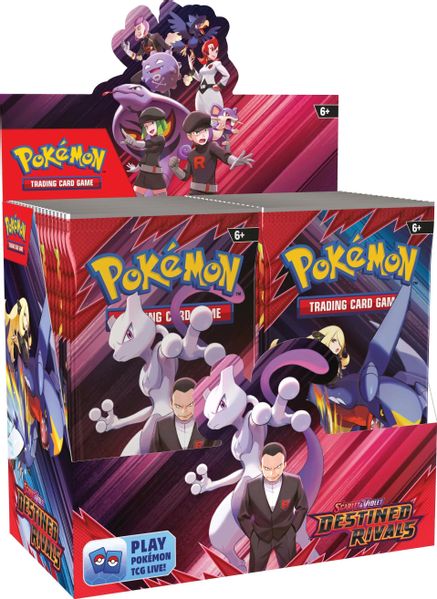
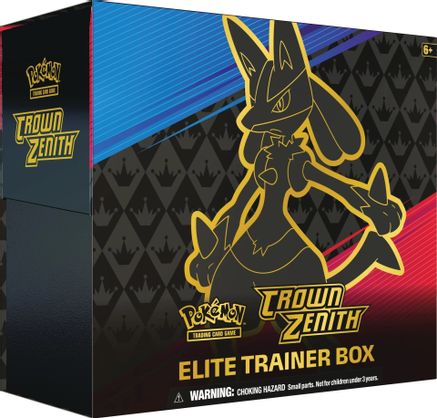
Read the two cards as roles. Destined Rivals is a Booster Box trading at $430.94 against a $161.64 MSRP; a product like this is the portfolio’s workhorse, the position whose value tracks the broad market for its era. Crown Zenith is a Elite Trainer Box at $314.73, a different ticket size aimed at a different buyer. A portfolio holding both types is not betting everything on one kind of demand.
Thesis. The most overlooked axis. If every position was bought for the same reason, say, “chase cards will drive opening,” then one piece of news that breaks that reasoning hits the whole portfolio at once. Deliberately mix theses: some scarcity plays, some chase-driven sets, some era-nostalgia holds.
Structure is about shape, not shopping lists. The table below shows how the same principles scale across four budget sizes. Every shape is illustrative: the point is the pattern of diversification and reserve, never a specific product to buy.
| Budget | Illustrative allocation shape | Cash reserve | What the shape does |
|---|---|---|---|
| $500 | 1 core booster box + 2 ETBs, all one game | ~$50–$75 | Teaches the full process at low stakes. Concentration is unavoidable at this size; the goal is learning, not optimization. |
| $1,000 | 2 booster boxes from different eras + 2 ETBs + 1 special-set product | ~$100–$150 | First real diversification: two eras, two product types, more than one thesis. |
| $5,000 | 6–8 booster boxes across 2 games and 3 eras + 4–6 ETBs + 2–3 collector products | ~$500–$750 | Adds the game axis and enough positions that no single one decides the outcome. |
| $10,000 | 10–14 booster boxes across 2–3 games, including 1–2 aged out-of-print anchors + 6–8 ETB and collector products | ~$1,000–$1,500 | Introduces aged anchors with finished print runs and forces genuine position-sizing discipline. |
These shapes are teaching illustrations, not recommendations for your money. TCG Quant is an analytics platform, not a licensed financial advisor, and nothing in this guide is personalized financial advice. Your objectives, horizon, and risk tolerance should reshape every number here.
Notice what stays constant as the budget grows: the reserve percentage barely moves, the number of positions grows faster than the size of each position, and the aged, expensive products only appear once the portfolio is large enough to absorb their concentration.
Cost basis is the all-in price you paid for a position: the product, plus tax, plus shipping, plus any fees. It is the only number your actual return is ever calculated from, and it is the number most collectors never write down. Record it at purchase, per position, every time. Two investors holding identical boxes can have opposite outcomes purely because of this number, and if you do not know yours, you cannot know whether you are winning.
The liquidity reserve is the 10–15% of the budget you deliberately do not spend. It exists for two reasons. First, opportunity: the best entries often appear on short notice, and a reserve lets you act without selling something else at a bad moment. Second, defense: a reserve is what stands between a personal cash crunch and a forced sale. A portfolio that is 100% invested is a portfolio with no steering wheel.
Everything in this guide converges on one habit: tracking. A position you can make decisions about has three numbers attached at all times: what you paid (cost basis), how many you hold (quantity), and what it is worth now (current market value). From those three, everything else is arithmetic: your unrealized gain, your position weights, your concentration risk, and eventually your realized return when you sell.
Without the ledger, every later decision degrades into feelings. Should you trim the position that doubled? Depends on its weight, which you cannot compute without quantities and marks. Is the portfolio too concentrated in one era? Same problem. Was the sale you made last year actually a good trade? Not answerable without the cost basis you recorded on day one. The investors who compound in this hobby are, almost without exception, the ones who kept records from the first purchase. Build the ledger the same day you build the portfolio, and every guide that follows this one, on selling, liquidity, and measuring returns, becomes usable instead of theoretical.
1. Decide objective, budget, horizon, and risk tolerance in writing before the first purchase. The document is the discipline.
2. Diversify across four axes, game, era, product type, and thesis, not just across quantities of the same box.
3. Let the budget set the shape. Small portfolios concentrate and learn; larger ones spread and add aged anchors. The reserve percentage stays roughly constant throughout.
4. Record all-in cost basis on day one, every time. It is the only number your return is calculated from.
5. Hold a liquidity reserve. Cash on the sidelines is what turns market surprises into opportunities instead of emergencies.
TCG Quant tracks supply, demand, pull rates, destruction, and Long-Term Scores across Pokemon and One Piece sealed product, updated daily.
Explore TCG Quant →